Fling Money and Forever Money: A Budget for Girls Who Fall in Love With Everything
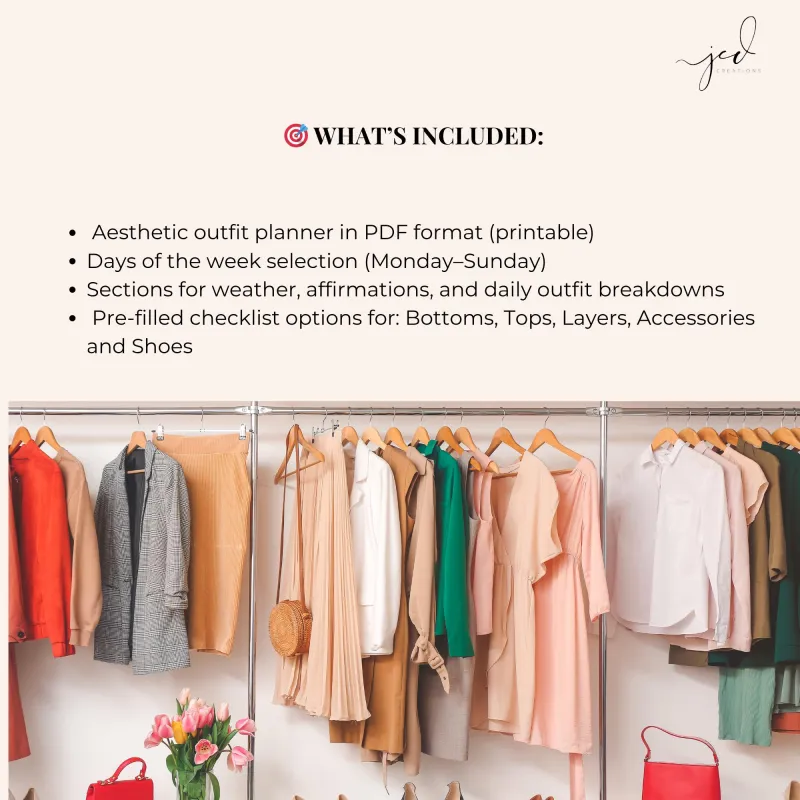
Photo: woman organizing wardrobe budget planner shopping journal aesthetic, via i.etsystatic.com
Let's say the thing no one says out loud in the checkout line: romantic shoppers have a problem, and it's beautiful and it's expensive.
We're the ones who buy the candle because the label felt like a Sunday morning. Who convince ourselves that this linen dress isn't a purchase, it's a chapter. We don't shop — we fall. And like any love affair that starts fast, half of these things end up unworn, tags on, in the back of the closet like exes we don't talk about.
But here's the twist: the same sensitivity that makes us impulse-buy also makes us uniquely capable of stopping. You can't reframe what you don't feel — and we feel everything.
The Two-Column Budget
Forget spreadsheets with 40 categories. You need two columns. That's it.
Column One: Fling Money. This is your designated fun fund — the stuff you buy for the thrill, fully aware it might not last. Trend pieces, that viral Target haul, the $22 top in a color you saw on Pinterest. For a US household bringing in roughly $65,000–$85,000 (single earner), a realistic fling budget is $75–$125 a month. Not zero. Zero doesn't work for people like us; we'll rebel by Tuesday.
Column Two: Forever Money. This is the commitment fund — money set aside monthly toward pieces you'll own in five years. The $300 leather jacket. The boots you'll resole twice. For the same income, aim for $150–$250 a month, saved until you can buy one quality piece every couple of months rather than three mediocre ones every weekend.
The rule that makes it work: a fling can never borrow from forever. Once the fling fund is empty, the fun is over until next month. That's not punishment — that's a boundary, and boundaries are romantic. Ask anyone in a good relationship.
Why Romance Is the Vulnerability (and the Cure)
Impulse spending research consistently points to the same trigger: emotion outpacing deliberation. Romantic shoppers are essentially running on emotion as a business model. Every purchase is a story, and we're suckers for a good story.
But that same storytelling instinct can work in reverse. When you delay a purchase, you're not denying yourself — you're courting it. You're letting the item prove itself. Does it still feel like a Sunday morning three weeks from now? Then it wasn't a fling. It was fate, and now you have the forever fund to back it up.
The 30-Day Courtship Challenge
For one month, you commit to the following:
- Buy nothing in the fling category. Forever-fund saving continues as normal.
- Keep a 'longing list.' Every impulse want gets written down with the date and — this is key — how you felt when you wanted it. Bored? Anxious? Scrolling after a weird text?
- Revisit the list on day 30. Circle what you still think about. Cross out what's become a stranger.
What typically happens: roughly 80% of the list dies on contact. The items you still want after a month? Those are rare, and you've just built the savings to buy one of them properly.
One reader who tried it, Dana from Portland, said it best: "By week three I realized I wasn't craving the stuff. I was craving the feeling of the wanting. Once I knew that, I could just... feel it. For free."
Restraint, but Make It Romantic
Here's the reframe to carry with you: every dollar you don't spend on a fling is a dollar saved for a piece that will love you back for a decade. That's not deprivation. That's loyalty. That's choosing the long, slow, patient kind of love over the exciting kind that leaves your closet full and your heart broke(r).
The hopelessly romantic shopper doesn't need to become cold. She needs to become devoted — to her future self, who deserves a wardrobe full of things that stayed.
Start the list. Fill the forever fund. Fall in love slower.